
pynibs.mesh package
Submodules
pynibs.mesh.mesh_struct module
- class pynibs.mesh.mesh_struct.Mesh(mesh_name, subject_id, subject_folder)
Bases:
object” Mesh class to initialize default attributes.
Methods
fill_defaults(approach)Initializes attributes for a headreco mesh.
print()Print self information.
write_to_hdf5(fn_hdf5[, check_file_exist, ...])Write this mesh' attributes to .hdf5 file.
- fill_defaults(approach)
Initializes attributes for a headreco mesh.
- print()
Print self information.
- write_to_hdf5(fn_hdf5, check_file_exist=False, verbose=False)
Write this mesh’ attributes to .hdf5 file.
- class pynibs.mesh.mesh_struct.ROI(subject_id, roi_name, mesh_name)
Bases:
object” Region of interest class to initialize default attributes.
Methods
print()Print self information.
write_to_hdf5(fn_hdf5[, check_file_exist, ...])Write this mesh' attributes to .hdf5 file.
- print()
Print self information.
- write_to_hdf5(fn_hdf5, check_file_exist=False, verbose=False)
Write this mesh’ attributes to .hdf5 file.
- class pynibs.mesh.mesh_struct.TetrahedraLinear(points, triangles, triangles_regions, tetrahedra, tetrahedra_regions)
Bases:
objectMesh, consisting of linear tetrahedra.
- Parameters
points (array of float [N_points x 3]) – Vertices of FE mesh
triangles (np.ndarray of int [N_tri x 3]) – Connectivity of points forming triangles
triangles_regions (np.ndarray of int [N_tri x 1]) – Region identifiers of triangles
tetrahedra (np.ndarray of int [N_tet x 4]) – Connectivity of points forming tetrahedra
tetrahedra_regions (np.ndarray of int [N_tet x 1]) – Region identifiers of tetrahedra
- triangles_normal
Normal components of triangles pointing outwards
- Type
np.ndarray of float [N_tri x 3]
Methods
calc_E(grad_phi, omegaA)Calculate electric field with gradient of electric potential and omega-scaled magnetic vector potential A.
calc_E_normal_tangential_surface(E, fname)Calculate normal and tangential component of electric field on given surfaces of mesh instance.
calc_E_on_GM_WM_surface(E, roi)Determines the normal and tangential component of the induced electric field on a GM-WM surface using nearest neighbour principle.
calc_E_on_GM_WM_surface3(phi, dAdt, roi[, ...])Determines the normal and tangential component of the induced electric field on a GM-WM surface by recalculating phi and dA/dt in an epsilon environment around the GM/WM surface (upper and lower GM-WM surface).
calc_E_on_GM_WM_surface_simnibs(phi, dAdt, ...)Determines the normal and tangential component of the induced electric field on a GM-WM surface by recalculating phi and dA/dt in an epsilon environment around the GM/WM surface (upper and lower GM-WM surface) or by using the Simnibs interpolation function.
calc_E_on_GM_WM_surface_simnibs_KW(phi, ...)Determines the normal and tangential component of the induced electric field on a GM-WM surface by recalculating phi and dA/dt in an epsilon environment around the GM/WM surface (upper and lower GM-WM surface) or by using the Simnibs interpolation function.
calc_J(E, sigma)Calculate current density J.
calc_QOI_in_points(qoi, points_out)Calculate QOI_out in points_out using the mesh instance and the quantity of interest (QOI).
calc_QOI_in_points_tet_idx(qoi, points_out, ...)Calculate QOI_out in points_out sitting in tet_idx using the mesh instance and the quantity of interest (QOI).
calc_gradient(phi)Calculate gradient of scalar DOF in tetrahedra center.
Determine the indices of the tetrahedra touching the surfaces and save the indices into a .txt file specified with fname.
data_elements2nodes(data)Transforms an data in tetrahedra into the nodes after Zienkiewicz et al. (1992) [1].
data_nodes2elements(data)Interpolate data given in the nodes to the tetrahedra center.
get_faces([tetrahedra_indexes])Creates a list of nodes in each face and a list of faces in each tetrahedra.
get_outside_faces([tetrahedra_indexes])Creates a list of nodes in each face that are in the outer volume.
- calc_E(grad_phi, omegaA)
Calculate electric field with gradient of electric potential and omega-scaled magnetic vector potential A.

- Parameters
- Returns
E – Electric field in tetrahedra center
- Return type
np.ndarray of float [N_tet x 3]
- calc_E_normal_tangential_surface(E, fname)
Calculate normal and tangential component of electric field on given surfaces of mesh instance.
- Parameters
- Returns
En_pos (np.ndarray of float [N_tri x 3]) – Normal component of electric field of top side (outside) of surface
En_neg (np.ndarray of float [N_tri x 3]) – Normal component of electric field of bottom side (inside) of surface
n (np.ndarray of float [N_tri x 3]) – Normal vector
Et (np.ndarray of float [N_tri x 3]) – Tangential component of electric field lying in surface
t (np.ndarray of float [N_tri x 3]) – Tangential vector
- calc_E_on_GM_WM_surface(E, roi)
Determines the normal and tangential component of the induced electric field on a GM-WM surface using nearest neighbour principle.
- Parameters
E (np.ndarray of float [N_tri x 3]) – Induced electric field given in the tetrahedra centre of the mesh instance
roi (pynibs.roi.RegionOfInterestSurface) – RegionOfInterestSurface object class instance
- Returns
E_normal (np.ndarray of float [N_points x 3]) – Normal vector of electric field on GM-WM surface
E_tangential (np.ndarray of float [N_points x 3]) – Tangential vector of electric field on GM-WM surface
- calc_E_on_GM_WM_surface3(phi, dAdt, roi, verbose=True, mode='components')
Determines the normal and tangential component of the induced electric field on a GM-WM surface by recalculating phi and dA/dt in an epsilon environment around the GM/WM surface (upper and lower GM-WM surface).
- Parameters
phi (np.ndarray of float [N_nodes x 1]) – Scalar electric potential given in the nodes of the mesh
dAdt (np.ndarray of float [N_nodes x 3]) – Magnetic vector potential given in the nodes of the mesh
roi (object instance) – RegionOfInterestSurface object class instance
verbose (boolean) – Print information to stdout
mode (str) – Select mode of output: - “components” : return x, y, and z component of tangential and normal components - “magnitude” : return magnitude of tangential and normal component (normal with sign for direction)
- Returns
E_normal (np.ndarray of float [N_points x 3]) – Normal vector of electric field on GM-WM surface
E_tangential (np.ndarray of float [N_points x 3]) – Tangential vector of electric field on GM-WM surface
- calc_E_on_GM_WM_surface_simnibs(phi, dAdt, roi, subject, verbose=False, mesh_idx=0)
Determines the normal and tangential component of the induced electric field on a GM-WM surface by recalculating phi and dA/dt in an epsilon environment around the GM/WM surface (upper and lower GM-WM surface) or by using the Simnibs interpolation function.
- Parameters
phi (np.ndarray of float [N_nodes x 1]) – Scalar electric potential given in the nodes of the mesh
dAdt (np.ndarray of float [N_nodes x 3]) – Magnetic vector potential given in the nodes of the mesh
roi (object instance) – RegionOfInterestSurface object class instance
subject (Subject object) – Subject object loaded from .hdf5 file
verbose (boolean) – Print information to stdout
mesh_idx (int) – Mesh index
- Returns
E_normal (np.ndarray of float [N_points x 3]) – Normal vector of electric field on GM-WM surface
E_tangential (np.ndarray of float [N_points x 3]) – Tangential vector of electric field on GM-WM surface
- calc_E_on_GM_WM_surface_simnibs_KW(phi, dAdt, roi, subject, verbose=False, mesh_idx=0)
Determines the normal and tangential component of the induced electric field on a GM-WM surface by recalculating phi and dA/dt in an epsilon environment around the GM/WM surface (upper and lower GM-WM surface) or by using the Simnibs interpolation function.
- Parameters
phi (np.ndarray of float [N_nodes x 1]) – Scalar electric potential given in the nodes of the mesh
dAdt (np.ndarray of float [N_nodes x 3]) – Magnetic vector potential given in the nodes of the mesh
roi (object instance) – RegionOfInterestSurface object class instance
subject (Subject object) – Subject object loaded from .hdf5 file
verbose (boolean) – Print information to stdout
mesh_idx (int) – Mesh index
- Returns
E_normal (np.ndarray of float [N_points x 3]) – Normal vector of electric field on GM-WM surface
E_tangential (np.ndarray of float [N_points x 3]) – Tangential vector of electric field on GM-WM surface
- calc_J(E, sigma)
Calculate current density J. The conductivity sigma is a list of np.arrays containing conductivities of regions (scalar and/or tensor).
![\mathbf{J} = [\sigma]\mathbf{E}](_images/math/7c84b320a199ca91d702d0915d87144067762f6f.png)
- calc_QOI_in_points(qoi, points_out)
Calculate QOI_out in points_out using the mesh instance and the quantity of interest (QOI).
- Parameters
- Returns
qoi_out – Quantity of interest in points_out
- Return type
np.ndarray of float
- calc_QOI_in_points_tet_idx(qoi, points_out, tet_idx)
Calculate QOI_out in points_out sitting in tet_idx using the mesh instance and the quantity of interest (QOI).
- Parameters
- Returns
qoi_out – Quantity of interest in points_out
- Return type
np.ndarray of float
- calc_gradient(phi)
Calculate gradient of scalar DOF in tetrahedra center.
- calc_surface_adjacent_tetrahedra_idx_list(fname)
Determine the indices of the tetrahedra touching the surfaces and save the indices into a .txt file specified with fname.
- Parameters
fname (str) – Filename of output .txt file
- Returns
<File> – Element indices of the tetrahedra touching the surfaces (outer-most elements)
- Return type
.txt file
- data_elements2nodes(data)
Transforms an data in tetrahedra into the nodes after Zienkiewicz et al. (1992) [1]. Can only transform volume data, i.e. needs the data in the surrounding tetrahedra to average it to the nodes. Will not work well for discontinuous fields (like E, if several tissues are used).
- Parameters
data (np.ndarray [N_elements x N_data]) – Data in tetrahedra
- Returns
data_nodes – Data in nodes
- Return type
np.ndarray [N_nodes x N_data]
Notes
- 1
Zienkiewicz, Olgierd Cecil, and Jian Zhong Zhu. “The superconvergent patch recovery and a posteriori error estimates. Part 1: The recovery technique.” International Journal for Numerical Methods in Engineering 33.7 (1992): 1331-1364.
- data_nodes2elements(data)
Interpolate data given in the nodes to the tetrahedra center.
- Parameters
data (np.ndarray [N_nodes x N_data]) – Data in nodes
- Returns
data_elements – Data in elements
- Return type
np.ndarray [N_elements x N_data]
- get_faces(tetrahedra_indexes=None)
Creates a list of nodes in each face and a list of faces in each tetrahedra.
- Parameters
tetrahedra_indexes (np.ndarray) – Indices of the tetrehedra where the faces are to be determined (default: all tetrahedra)
- Returns
faces (np.ndarray) – List of nodes in faces, in arbitrary order
th_faces (np.ndarray) – List of faces in each tetrahedra, starts at 0, order=((0, 2, 1), (0, 1, 3), (0, 3, 2), (1, 2, 3))
face_adjacency_list (np.ndarray) – List of tetrahedron adjacent to each face, filled with -1 if a face is in a single tetrahedron. Not in the normal element ordering, but only in the order the tetrahedra are presented
- get_outside_faces(tetrahedra_indexes=None)
Creates a list of nodes in each face that are in the outer volume.
- Parameters
tetrahedra_indices (np.ndarray) – Indices of the tetrehedra where the outer volume is to be determined (default: all tetrahedra)
- Returns
faces – List of nodes in faces in arbitrary order
- Return type
np.ndarray
pynibs.mesh.transformations module
- pynibs.mesh.transformations.cell_data_to_point_data(tris, data_tris, nodes, method='nearest')
A wrapper for scipy.interpolate.griddata to interpolate cell data to node data.
- Parameters
tris (np.ndarray) – element number list, (n_tri, 3)
data_tris (np.ndarray) – data in tris, (n_tri x 3)
nodes (np.ndarray) – nodes coordinates, (n_nodes, 3
method (str, default: 'nearest') – Which method to use for interpolation. Default uses NearestNDInterpolator
- Returns
data_nodes – Data in nodes
- Return type
np.ndarray
- pynibs.mesh.transformations.data_elements2nodes(data, con, precise=False)
Transforms data in elements (triangles or tetrahedra) to nodes. Data can be list of multiple data arrays.
- Parameters
data (np.ndarray of float or list of np.ndarray) – (N_elements, N_data) Data given in the elements (multiple datasets who fit to con may be passed in a list)
con (np.ndarray of int) – triangles: (N_elements. 3) tetrahedra: (N_elements, 4) Connectivity index list forming the elements
precise (bool, default: False) – Compute data transformation precisely but slow. Better for near-0 values.
- Returns
out – (N_nodes, N_data) Data in nodes
- Return type
- pynibs.mesh.transformations.data_nodes2elements(data, con)
Transforms data in nodes to elements (triangles or tetrahedra)
- Parameters
- Returns
out – (N_elements, N_data) Data given in the element scenters
- Return type
np.ndarray of float
- pynibs.mesh.transformations.map_data_to_surface(datasets, points_datasets, con_datasets, fname_fsl_gm, fname_fsl_wm, fname_midlayer=None, delta=0.5, input_data_in_center=True, return_data_in_center=True, data_substitute=-1)
Maps data from ROI of fsl surface (wm, gm, or midlayer) to given Freesurfer brain surface (wm, gm, inflated).
- Parameters
datasets (np.ndarray of float [N_points x N_data] or list of np.ndarray) – Data in nodes or center of triangles in ROI (specify this in “data_in_center”)
points_datasets (np.ndarray of float [N_points x 3] or list of np.ndarray) – Point coordinates (x,y,z) of ROI where data in datasets list is given, the points have to be a subset of the GM/WM surface (has to be provided for each dataset)
con_datasets (np.ndarray of int [N_tri x 3] or list of np.ndarray) – Connectivity matrix of dataset points (has to be provided for each dataset)
fname_fsl_gm (str or list of str or list of None) – Filename of pial surface fsl file(s) (one or two hemispheres) e.g. in mri2msh: …/fs_ID/surf/lh.pial
fname_fsl_wm (str or list of str or list of None) – Filename of wm surface fsl file(s) (one or two hemispheres) e.g. in mri2msh: …/fs_ID/surf/lh.white
fname_midlayer (str or list of str) – Filename of midlayer surface fsl file(s) (one or two hemispheres) e.g. in headreco: …/fs_ID/surf/lh.central
delta (float) – Distance parameter where gm-wm surface was generated 0…1 (default: 0.5) 0 -> WM surface 1 -> GM surface
input_data_in_center (bool) – Flag if data in datasets in given in triangle centers or in points (Default: True)
return_data_in_center (bool) – Flag if data should be returned in nodes or in elements (Default: True)
data_substitute (float) – Data substitute with this number for all points in the inflated brain, which do not belong to the given data set
- Returns
data_mapped – Mapped data to target brain surface. In points or elements
- Return type
np.ndarray of float [N_points_inf x N_data]
- pynibs.mesh.transformations.midlayer_2_surf(midlayer_data, coords_target, coords_midlayer, midlayer_con=None, midlayer_data_in_nodes=False, max_dist=5, outside_roi_val=0, precise_map=True)
Convert midlayer data to whole-brain surface data, e.g. grey matter. Output is returned as data in nodes.
- pynibs.mesh.transformations.project_on_scalp(coords, mesh, scalp_tag=1005)
Find the node in the scalp closest to each coordinate
- Parameters
coords (nx3 np.ndarray) – Vectors to be transformed
mesh (pynibs.TetrahedraLinear or simnibs.msh.mesh_io.Msh) – Mesh structure in simnibs or pynibs format
scalp_tag (int, optional, default: 1005) – Tag in the mesh where the scalp is to be set. Default: 1005
- Returns
points_closest – (n, 3) coordinates projected scalp (closest skin points)
- Return type
np.ndarry
- pynibs.mesh.transformations.project_on_scalp_hdf5(coords, mesh, scalp_tag=1005)
Find the node in the scalp closest to each coordinate
- Parameters
- Returns
points_closest – coordinates projected scalp (closest skin points)
- Return type
nx3 np.ndarray
- pynibs.mesh.transformations.refine_surface(fn_surf, fn_surf_refined, center, radius, repair=True, remesh=True, verbose=True)
Refines surface (.stl) in spherical ROI an saves as .stl file.
- Parameters
fn_surf (str) – Input filename (.stl)
fn_surf_refined (str) – Output filename (.stl)
center (np.ndarray of float (3)) – Center of spherical ROI (x,y,z)
radius (float) – Radius of ROI
repair (bool, optional, default: True) – Repair surface mesh to ensure that it is watertight and forms a volume
remesh (bool, optional, default:False) – Perform remeshing with meshfix (also removes possibly overlapping facets and intersections)
verbose (bool, optional, default: True) – Print output messages
- Returns
<file>
- Return type
.stl file
pynibs.mesh.utils module
- pynibs.mesh.utils.calc_gradient_surface(phi, points, triangles)
Calculate gradient of potential phi on surface (i.e. tangential component) given in vertices of a triangular mesh forming a 2D surface.
- Parameters
- Returns
grad_phi – Gradient of potential phi on surface
- Return type
np.ndarray of float [N_tri x 3]
- pynibs.mesh.utils.calc_tet_volume(points, abs=True)
Calculate tetrahedra volumes.
- pynibs.mesh.utils.calc_tetrahedra_volume_cross(P1, P2, P3, P4)
Calculates volume of tetrahedra specified by the 4 points P1…P4 multiple tetrahedra can be defined by P1…P4 as 2-D np.arrays using the cross and vector dot product
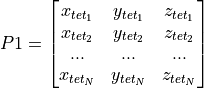
- Parameters
P1 (np.ndarray of float [N_tet x 3]) – Coordinates of first point of tetrahedra
P2 (np.ndarray of float [N_tet x 3]) – Coordinates of second point of tetrahedra
P3 (np.ndarray of float [N_tet x 3]) – Coordinates of third point of tetrahedra
P4 (np.ndarray of float [N_tet x 3]) – Coordinates of fourth point of tetrahedra
- Returns
tetrahedra_volume – Volumes of tetrahedra
- Return type
np.ndarray of float [N_tet x 1]
- pynibs.mesh.utils.calc_tetrahedra_volume_det(P1, P2, P3, P4)
Calculate volume of tetrahedron specified by 4 points P1…P4 multiple tetrahedra can be defined by P1…P4 as 2-D np.arrays using the determinant.
- Parameters
P1 (np.ndarray of float [N_tet x 3]) – Coordinates of first point of tetrahedra
P2 (np.ndarray of float [N_tet x 3]) – Coordinates of second point of tetrahedra
P3 (np.ndarray of float [N_tet x 3]) – Coordinates of third point of tetrahedra
P4 (np.ndarray of float [N_tet x 3]) – Coordinates of fourth point of tetrahedra
- Returns
tetrahedra_volume – Volumes of tetrahedra
- Return type
np.ndarray of float [N_tet x 1]
- pynibs.mesh.utils.calc_tri_surface(points)
Calculate triangle surface areas.
- pynibs.mesh.utils.check_islands_for_single_elm(source_elm, connectivity=None, adjacency=None, island_crit=1)
This identifies islands in a mesh for a given element. An island is a set of elements, that is only connect via a single node to another set of elements. These islands usually crash the FEM solver and should be removed.
Find all elements connect to source_elm via one node (1-node-neighbor)
Start with source_elm and visit all 2-node-neighbors (‘shared-edge)
Continue recursively with all 2-node-neighbors and visit their 2-node-neighbors
See if any 1-node-neighbors have not been visited with this strategy. If so, an island has been found
- Parameters
source_elm (int) – The source element to check
connectivity (np.ndarray, optional) – Connectivity (‘node_number_list’) starting with 0. Can be triangles or tetrahedra (n_elms, 3) or (n_elms_4).
adjacency (np.ndparray, optional) – Adjenceny matrix (n_elm, n_elm). Weights are supposed to be number of shared nodes. Computed from neighbors if not provided.
island_crit (int, optional, default: 'any') – How many nodes to define islands? ‘any’ -> Elements connected via a single node or single edge are defined as an island. ‘node’ -> Elements connected via a single _node_ are defined as an island. ‘edge’ -> Elements connected via a single _edge_ are defined as an island.
- Returns
n_visited (int)
n_not_visited (int)
neighbors_visited (dict, which neighbors have been visited and which have not)
- pynibs.mesh.utils.determine_e_midlayer(fn_e_results, fn_mesh_hdf5, subject, mesh_idx, roi_idx, n_cpu=4, midlayer_fun='simnibs', phi_scaling=1.0, verbose=False)
Parallel version to determine the midlayer e-fields from a list of .hdf5 results files
- Parameters
fn_e_results (list of str) – List of results filenames (.hdf5 format)
fn_mesh_hdf5 (str) – Filename of corresponding mesh file
subject (pynibs.Subject) – Subject object
mesh_idx (int) – Mesh index
roi_idx (int) – ROI index
n_cpu (int, optional, default: 4) – Number of parallel computations
midlayer_fun (str, optional, default: "simnibs") – Method to determine the midlayer e-fields (“pynibs” or “simnibs”)
phi_scaling (float, optional, default: 1.0) – Scaling factor of scalar potential to change between “m” and “mm”
- Returns
Adds midlayer e-field results to ROI
- Return type
<File> .hdf5 file
- pynibs.mesh.utils.determine_e_midlayer_workhorse(fn_e_results, subject, mesh_idx, midlayer_fun, fn_mesh_hdf5, roi_idx, phi_scaling=1.0, verbose=False)
- phi_scaling: float
simnibs < 3.0 : 1000. simnibs >= 3.0 : 1. (Default)
- pynibs.mesh.utils.find_element_idx_by_points(nodes, con, points)
Finds the tetrahedral element index of an arbitrary point in the FEM mesh.
- Parameters
nodes (np.ndarray [N_nodes x 3]) – Coordinates (x, y, z) of the nodes
con (np.ndarray [N_tet x 4]) – Connectivity matrix
points (np.ndarray [N_points x 3]) – Points for which the element indices are found.
- Returns
ele_idx – Element indices of tetrahedra where corresponding ‘points’ are lying in
- Return type
np.ndarray [N_points]
- pynibs.mesh.utils.find_island_elms(connectivity=None, adjacency=None, verbose=False, island_crit='edge', decision='cumulative')
Searches for islands in a mesh and returns element indices of the smallest island. Island is defines as a set of elements, which share a single node and/or single edge with the rest of the mesh.
- Parameters
connectivity (np.ndarray, optional) – Connectivity (‘node_number_list’) starting with 0. Can be triangles or tetrahedra (n_elms, 3) or (n_elms_4).
adjacency (np.ndparray, optional) – Adjenceny matrix (n_elm, n_elm). Weights are supposed to be number of shared nodes. Computed from neighbors if not provided.
island_crit (int, optional, default: 'edge') – How many nodes to define islands? ‘node’ -> Elements connected via a single _node_ are defined as an island. ‘edge’ -> Elements connected via a single _edge_ are defined as an island.
decision (string, optional, default: cumulative) – ‘cumulative’ -> Return all element indices that are not visited any times ‘smallest’ -> Return smallest island.
verbose (bool, optional) – Print some verbosity information. Default: False
- Returns
island
- Return type
list of island-elms
- pynibs.mesh.utils.find_islands(connectivity=None, adjacency=None, island_crit='any', verbose=False)
This identifies islands in a mesh. An island is a set of elements, that is only connect via a single node to another set of elements. These islands usually crash the FEM solver and should be removed.
- For each element:
Find all elements connect to source_elm via one node (1-node-neighbor)
Start with source_elm and visit all 2-node-neighbors (‘shared-edge)
Continue recursively with all 2-node-neighbors and visit their 2-node-neighbors
See if any 1-node-neighbors have not been visited with this strategy. If so, an island has been found
- Parameters
connectivity (np.ndarray, optional) – Connectivity (‘node_number_list’) starting with 0. Can be triangles or tetrahedra (n_elms, 3) or (n_elms_4).
adjacency (np.ndparray, optional) – Adjenceny matrix (n_elm, n_elm). Weights are supposed to be number of shared nodes. Computed from neighbors if not provided.
island_crit (int, optional, default: 'any') – How many nodes to define islands? ‘any’ -> Elements connected via a single node or single edge are defined as an island. ‘node’ -> Elements connected via a single _node_ are defined as an island. ‘edge’ -> Elements connected via a single _edge_ are defined as an island.
verbose (bool, optional) – Print some verbosity information. Default: False
- Returns
elms_with_island (list) – Elements with neighboring islands
counter_visited (np.ndarray) – shape = (n_elms). How often as each element been visited.
counter_not_visited (np.ndarray) – shape = (n_elms). How often as each element not been visited.
- pynibs.mesh.utils.find_nearest(array, value)
Given an “array”, and given a “value” , returns an index j such that “value” is between array[j] and array[j+1]. “array” must be monotonic increasing. j=-1 or j=len(array) is returned to indicate that “value” is out of range below and above respectively.
- pynibs.mesh.utils.get_indices_discontinuous_data(data, con, neighbor=False, deviation_factor=2, min_val=None, not_fitted_elms=None, crit='median', neigh_style='point')
Get element indices (and the best neighbor index), where the data is discontinuous
- Parameters
data (np.ndarray of float [n_data]) – Data array to analyze given in the element center
con (np.ndarray of float [n_data, 3 or 4]) – Connectivity matrix
neighbor (boolean, optional, default=False) – Return also the element index of the “best” neighbor (w.r.t. median of data)
deviation_factor (float) – Allows data deviation from 1/deviation_factor < data[i]/median < deviation_factor
min_val (float, optional) – If given, only return elements which have a neighbor with data higher than min_val.
not_fitted_elms (np.ndarray) – If given, these elements are not used as neighbors
crit (str, default: median) – Criterium for best neighbor. Either median or max value
neigh_style (str, default: 'point') – Should neighbors share point or ‘edge’
- Returns
idx_disc (list of int [n_disc]) – Index list containing the indices of the discontinuous elements
idx_neighbor (list of int [n_disc]) – Index list containing the indices of the “best” neighbors of the discontinuous elements
- pynibs.mesh.utils.get_sphere(mesh=None, mesh_fn=None, target=None, radius=None, roi_idx=None, roi=None, elmtype='tris')
Return element idx of elements within a certain distance to provided target. Element indices are 0-based (tris and tets start at 0, ‘pynibs’ style) Elements might be ‘tris’ (default) or ‘tets’
If roi object / idx and mesh fn is provided, the roi is expected to have midlayer information and the roi geometry is used.
- Parameters
mesh (pynibs.mesh.TetrahedraLinear, optional) –
mesh_fn (str, optional) – Filename to SimNIBS .msh or pyNIBS .hdf5 mesh file
target (np.ndarray of float, optional) – (3,) X, Y, Z coordinates of target
radius (float, optional) – Sphere radius im mm
elmtype (str, optional) – Return triangles or tetrahedra in sphere around target. One of (‘tris’, ‘tets’)
- Returns
elms_in_sphere – (n_elements): Indices of elements found in ROI
- Return type
np.ndarray
- pynibs.mesh.utils.in_hull(points, hull)
Test if points in points are in hull. points should be a [N x K] coordinates of N points in K dimensions. hull is either a scipy.spatial.Delaunay object or the [M x K] array of the coordinates of M points in Kdimensions for which Delaunay triangulation will be computed.
- Parameters
points (np.ndarray) – (N_points x 3) Set of floating point data to test whether they are lying inside the hull or not
hull (scipy.spatial.Delaunay or np.ndarray) – (M x K) Surface data
- Returns
inside – TRUE: point inside the hull FALSE: point outside the hull
- Return type
np.ndarray of bool
- pynibs.mesh.utils.sample_sphere(n_points, r)
Creates n_points evenly spread in a sphere of radius r.
- pynibs.mesh.utils.tets_in_sphere(mesh, target, radius, roi)
Worker function for get_sphere()
Returns element idx of elements within a certain distance to provided target. If roi object / idx and mesh fn is provided, the roi is expected to have midlayer information and the roi geometry is used.
- Parameters
- Returns
tets_in_sphere – (n_tets): Indices of elements found in ROI
- Return type
np.ndarray
- pynibs.mesh.utils.tris_in_sphere(mesh, target, radius, roi)
Worker function for get_sphere().
Returns triangle idx of elements within a certain distance to provided target. If roi object / idx and mesh fn is provided, the roi is expected to have midlayer information and the roi geometry is used.
- Parameters
- Returns
tris_in_sphere – (n_triangles): Indices of elements found in sphere
- Return type
np.ndarray